
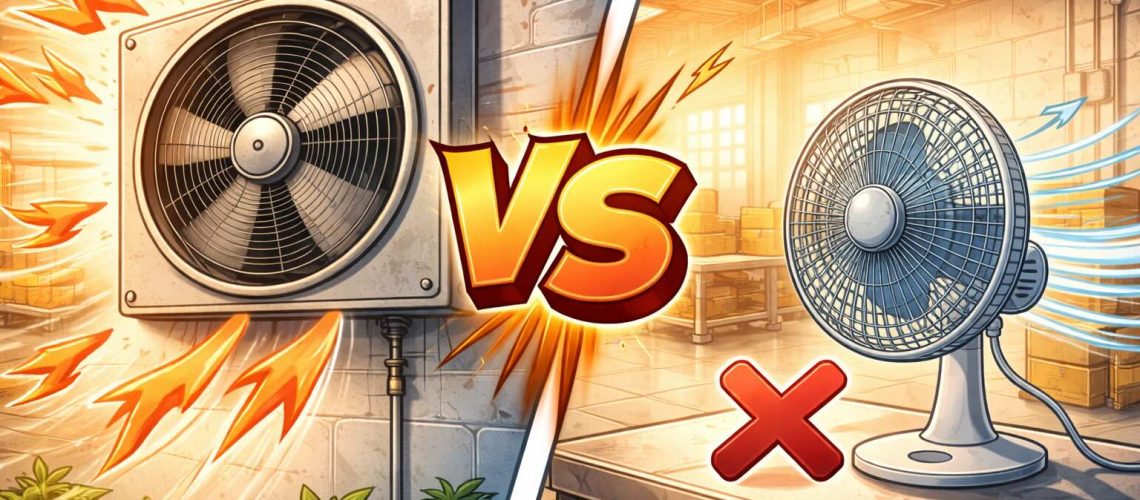
In many factories and warehouses, table fans are often the first response to heat complaints. They are inexpensive, easy to deploy, and provide immediate airflow to workers.
However, while table fans may feel cooling at first, they do not reduce heat buildup inside industrial spaces — especially in facilities with heavy machinery, poor airflow, or limited exhaust points.
The Problem with Using Table Fans in Industrial Environments
Table fans only circulate existing air. In hot factories, this air is already warm, humid, and often contaminated with fumes, dust, or process heat.
Instead of removing heat, fans can:
Push hot air back toward workers
Spread airborne contaminants
Increase dehydration and heat fatigue
Create a false sense of “cooling” without reducing actual temperature
According to NIOSH heat stress guidance, moving hot air does not lower core body temperature when ambient heat remains high.
Heat Stress Is a Ventilation Problem — Not a Fan Problem
Factories experiencing frequent worker fatigue, sweating, or reduced productivity are usually facing heat accumulation, not airflow shortage.
This is why factory heat stress and ventilation must be addressed at the building level — not just at individual workstations.
When heat is not exhausted from the space, it continues to accumulate throughout the day, especially in:
Metal fabrication plants
Packaging and logistics warehouses
Injection moulding and processing facilities
Why Table Fans Cannot Replace an Industrial Exhaust System
An industrial exhaust system for factories works differently from fans.
Instead of circulating heat, exhaust systems:
Remove hot air at high level
Create pressure balance that draws in cooler replacement air
Prevent heat recirculation
Reduce long-term thermal load inside the building
Without proper exhaust, even multiple fans will only move heat around — not remove it.
What Proper Ventilation Actually Does
Effective ventilation relies on airflow design, not just air movement.
A correctly designed exhaust system considers:
Heat source location
Exhaust fan airflow capacity
Intake air paths
Roof and wall exhaust placement
This is why exhaust fan airflow design matters more than the number of fans used.
When Are Table Fans Still Useful?
Table fans can still play a supporting role:
Localised comfort after heat is controlled
Temporary use during low-heat operations
Personal cooling when ambient temperature is already managed
But they should never be the primary heat control method in factories.
The Right Way to Reduce Factory Heat
For long-term safety and productivity, factories should prioritise:
Heat exhaust at roof or wall level
Controlled fresh air intake
Proper airflow direction planning
Ventilation systems sized to actual heat load
Table fans can complement ventilation — but they cannot replace it.
Conclusion
If workers still feel exhausted despite multiple fans, the issue isn’t manpower or discipline — it’s heat removal.
True cooling in factories starts with exhausting heat, not pushing it around.