Evaporative Air Cooler Guide for Industrial & Commercial Use in Malaysia

*This guide is designed for businesses and facility managers seeking industrial evaporative air cooler solutions in Malaysia — from cost, performance, installation to maintenance.

Evaporative air coolers Malaysia have become one of the most practical cooling solutions for factories, warehouses, and commercial buildings across nation. Unlike air conditioners that rely on enclosed spaces and high energy consumption, evaporative air cooling focuses on fresh air circulation, heat removal, and energy efficiency — making it ideal for large, open or semi-open environments.

Throughout this page you will understand how evaporative air coolers work, where they perform best, when they should not be used, and how businesses in Malaysia can decide whether this cooling approach is suitable for their operations.

What Is an Evaporative Air Cooler?

Most people do not understand what an evaporative cooling system is. An evaporative air cooler is a cooling system that reduces air temperature through the natural process of water evaporation. Hot outdoor air is drawn into the unit, passed through water-saturated cooling pads, and then delivered as cooler, fresh air into the building.

From an HVAC engineering perspective, evaporative cooling is a well-established method, and ASHRAE defines evaporative cooling as a process that reduces air temperature through the evaporation of water, without the use of refrigerants or compressors.

Unlike conventional air conditioning systems:

  • There is no refrigerant

  • There is no recirculation of stale indoor air

  • Cooling is achieved using water and airflow

This makes evaporative air coolers fundamentally different from air conditioners — they are designed to cool people and processes, not sealed rooms.

How Evaporative Air Cooling Works in Industrial & Commercial Buildings

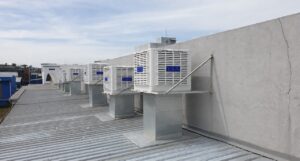
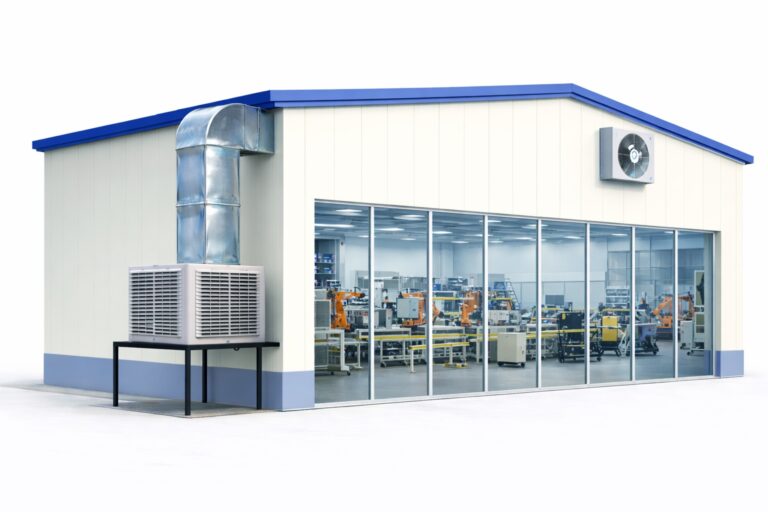
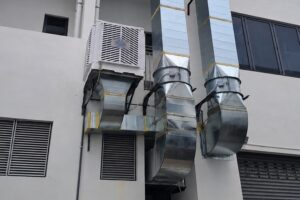
In Malaysia, evaporative air cooling system is mainly used for industrial instead of residential and we must understand how evaporative air cooling systems work in industrial applications. In real-world industrial applications, evaporative air coolers are almost always installed outside the building. The system draws in hot ambient air, cools it through evaporation, and supplies the cooled air indoors using square or rectangular ducting.

Key characteristics of industrial evaporative cooling systems include:

  • Outdoor installation on wall brackets or platforms

  • Continuous supply of fresh air

  • Heat removal through air replacement, not trapping cold air

  • Compatibility with large floor areas and high ceilings

This approach works particularly well in factories and warehouses where heat is constantly generated by machinery, lighting, and human activity.

CrystalAir Overall Industrial Ventilation With Evaporative Air Coler Illustration.

Is Evaporative Air Cooling Suitable for Malaysia?

Malaysia’s hot climate makes evaporative air cooling especially effective for the right type of environment. While humidity is often misunderstood, evaporative coolers are designed to replace hot air, not accumulate moisture. This is fundamental to avoid any heat stress for workers as mentioned by NIOSH. Here is the detail on actual room temperature impact of evaporative air coolers for your understanding.

Evaporative air cooling is suitable in Malaysia when:

  • The space is large or semi-open

  • There is adequate air movement and exhaust

  • Heat load is high due to machinery or occupancy

It is less about achieving a fixed temperature and more about thermal comfort, airflow, and heat reduction — which is exactly what many industrial and commercial spaces require. 

Where Evaporative Air Coolers Perform Best

Evaporative air coolers are widely used across Malaysia in environments such as:

  • Factories and production floors. (Related reading : industrial air coolers for better productivity)

  • Warehouses and logistics centres

  • Commercial kitchens and food processing areas

  • Restaurants and dining spaces

  • Assembly areas and workshops

  • Loading bays and semi-open structures

Find out how air coolers improve productivity in factories and warehouses here.

In these spaces, air conditioners are often impractical due to:

  • Large open doors

  • High ceilings

  • Continuous heat generation

Evaporative cooling provides a more sustainable and cost-effective solution for these conditions. From a building services standpoint, professional bodies such as CIBSE highlight that ventilation-based cooling strategies are particularly effective in large spaces with high heat loads and frequent air exchange.

For your information, evaporative air cooling system is a widely welcomed by kopitiam style restaurants and foodcourt in Malaysia, here is the reason why restaurants in Malaysia prefer air coolers over air conditioners.

Where Evaporative Air Coolers Are NOT Recommended

Evaporative air coolers are not suitable for every application. They are generally not recommended for:

  • Small enclosed offices

  • Server rooms or data centres

  • Sealed environments with no exhaust

  • Areas requiring precise temperature and humidity control

Understanding these limitations is important. Choosing the correct cooling system ensures performance, comfort, and long-term cost efficiency.

Evaporative Air Coolers vs Air Conditioners

Evaporative air coolers vs air conditioners serve different purposes.

Air conditioners:

  • Recirculate indoor air

  • Work best in sealed rooms

  • Consume higher electrical power

  • Provide precise temperature control

Evaporative air coolers:

  • Supply continuous fresh air

  • Work best in open or ventilated spaces

  • Consume significantly less electricity

  • Focus on heat reduction and airflow

According to the U.S. Department of Energy, evaporative coolers typically consume significantly less electricity than conventional air conditioning systems, particularly when used in large, well-ventilated spaces.

For many factories and warehouses in Malaysia, evaporative air cooling offers a more practical solution where air conditioning would be inefficient or cost-prohibitive.

Choosing the Right Evaporative Air Cooler System

Selecting the right system involves more than choosing a unit size. Important considerations include:

  • Airflow requirement (CFM or m³/h)

  • Floor area and ceiling height

  • Heat sources within the space

  • Ducting layout and air distribution

  • Number of units required for even cooling

A properly designed system ensures that cooled air reaches occupied zones effectively without creating hotspots. Proper ventilation is also linked to indoor environmental quality, and World Health Organization indoor air quality guidelines emphasise the importance of adequate airflow in occupied workplaces.

It is recommended to go through air cooler buying guide for commercial and industrial use before making decisions.

Installation Approach for Factories & Warehouses

In industrial applications, this is how to install commercial air coolers in warehouses and in short evaporative air coolers are typically:

  • Mounted externally on steel brackets

  • Connected via square or rectangular ducting

  • Positioned to deliver air evenly across work areas

External installation simplifies maintenance, preserves indoor space, and ensures optimal intake of fresh air. Proper planning of duct routing and discharge points is essential for effective cooling performance.

Maintenance, Lifespan & Replacement Considerations

Like all mechanical systems, evaporative cooling system maintenance requirements must be observed for optimal performance.Here are the reasons why warehouse air coolers need regular maintenance. Typical maintenance includes:

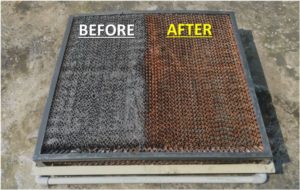
  • Cleaning or replacing cooling pads

  • Checking water distribution systems

  • Inspecting fans and motors

  • Ensuring proper drainage

With proper maintenance, industrial evaporative air coolers can provide reliable service for many years. Performance decline, excessive water usage, or repeated repairs may indicate that replacement is more economical than continued servicing. Here is the signs that an air cooler should be replaced.

Evaporative Air Cooler Cooling Pad before and after cleaning.

Cost, Energy Consumption & Return on Investment

One of the biggest advantages of evaporative air cooling is low operating cost. Compared to air conditioning:

  • Power consumption is significantly lower

  • Systems scale more economically for large spaces

  • Productivity improves due to better airflow and comfort

By real-world experience, industrial air cooler solutions in Malaysia are proven the return on investment is achieved not only through energy savings, but also through improved working conditions and operational efficiency. i

Rental & Temporary Cooling Solutions

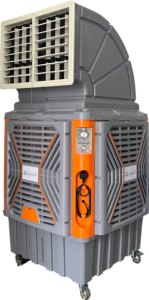
CrystalAir Portable Evaporative Air Cooler PC-150

Evaporative air coolers are also suitable for temporary applications such as:

  • Peak production periods

  • Temporary facilities

  • Renovation projects

  • Emergency cooling needs

Rental solutions allow businesses to address short-term cooling requirements without long-term capital investment. Know more about air cooler rental solutions in Malaysia here.

Frequently Asked Questions

Yes, when used in ventilated spaces with adequate airflow.

Yes, if the space is fully concealed. For ventilated place, the system replaces hot air with cooled fresh air rather than trapping moisture.

This depends on floor area, ceiling height, heat load, and airflow requirements.

For medium to large industrial spaces, installation and operating costs are typically much lower.

Talk to a Cooling Specialist

Every building is different. The effectiveness of an evaporative air cooling system depends on proper assessment, design, and installation.

If you are considering evaporative air cooling for your factory, warehouse, or commercial space in Malaysia, a professional site assessment will help determine the most suitable solution for your requirements.