
When selecting or maintaining an industrial chiller, one of the most common technical questions facility managers face is:
Should we use a centrifugal chiller or a screw chiller?
Both technologies are widely used in Malaysia, but they differ significantly in maintenance requirements, efficiency, operating range, and lifecycle cost.
This guide provides a practical comparison to help facility managers make informed decisions.
Overview: Centrifugal vs Screw Chillers
|
Feature |
Centrifugal Chiller |
Screw Chiller |
|
Compressor type |
Dynamic (centrifugal) |
Positive displacement |
|
Typical capacity range |
Medium to very large |
Small to medium |
|
Part-load efficiency |
Excellent |
Good |
|
Mechanical complexity |
Higher |
Lower |
|
Maintenance skill level |
Higher |
Moderate |
How Centrifugal Chillers Work
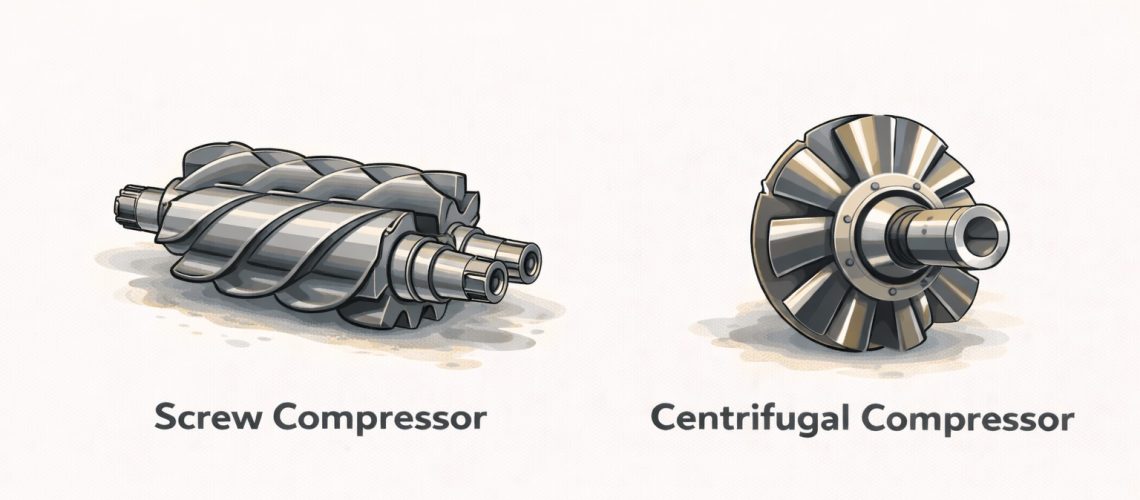
Centrifugal chillers use high-speed impellers to compress refrigerant.
They are most efficient when operating at stable loads and higher capacities.
Common applications:
- District cooling
- Large commercial buildings
- Hospitals
- Data centres
- Industrial process cooling
How Screw Chillers Work
Screw chillers use rotary screw compressors to compress refrigerant in a fixed volume.
Common applications:
- Manufacturing plants
- Medium-sized facilities
- Variable-load industrial processes
- Facilities requiring redundancy with multiple chillers
Maintenance Comparison
Centrifugal Chiller Maintenance
Centrifugal chillers typically require:
- Skilled technicians
- Precise alignment and balancing
- Bearing and seal monitoring
- Oil system maintenance
- Performance trend analysis
Because of their high-speed operation, maintenance quality directly affects reliability.
Related article:
What Happens During a Professional Chiller Overhaul? A Step-by-Step Guide
Screw Chiller Maintenance
Screw chillers generally:
- Are more tolerant of load variation
- Have fewer high-speed components
- Require simpler mechanical servicing
- Are easier to troubleshoot
However, they may require:
- More frequent oil changes
- Regular inspection of rotors and bearings
Energy Efficiency & Operating Behaviour
Centrifugal Chillers
- Excellent full-load and part-load efficiency
- Highly efficient at stable operating conditions
- Sensitive to condenser water quality and fouling
Standards such as those published by ASHRAE often highlight centrifugal chillers for large-capacity, high-efficiency systems.
Screw Chillers
- Good efficiency at varying loads
- More forgiving of fluctuating conditions
- Slightly lower peak efficiency compared to centrifugal chillers
Reliability & Operational Risk
|
Aspect |
Centrifugal |
Screw |
|
Load stability tolerance |
Lower |
Higher |
|
Sensitivity to fouling |
Higher |
Moderate |
|
Failure impact |
High (large systems) |
Moderate |
|
Redundancy strategy |
Fewer large units |
Multiple smaller units |
Lifecycle & Overhaul Considerations
Centrifugal Chillers
- Longer potential service life (20–25+ years)
- Higher overhaul complexity
- Significant efficiency recovery possible through overhaul
Related reading:
Chiller Overhaul vs Replacement: Which Is More Cost-Effective in Malaysia?
Screw Chillers
- Shorter typical service life (15–20 years)
- Easier component replacement
- Lower overhaul cost but smaller efficiency gains
Which Chiller Type Is Right for Your Facility?
Choose a Centrifugal Chiller if:
- Cooling load is large and stable
- Energy efficiency is a top priority
- Skilled maintenance support is available
- Long-term lifecycle cost matters most
Choose a Screw Chiller if:
- Load varies frequently
- Simpler maintenance is preferred
- Redundancy is required
- Initial cost sensitivity is higher
Conclusion: There Is No “Better” Chiller — Only the Right Application
Centrifugal and screw chillers each excel in different operating environments.
The best choice depends on:
- Capacity requirement
- Load profile
- Maintenance capability
- Energy cost considerations
- Long-term operational strategy
Understanding these differences helps facility managers make decisions that are technically sound and financially justified.