
When evaluating a chiller, one of the first things people normally look at is the chilled-water temperature.
If the leaving water is colder, the natural assumption is that the chiller must be performing better.
However, this can be misleading.
For industrial and process cooling applications, the actual purpose of a chiller is not simply to produce the lowest possible water temperature. The real objective is to remove enough heat from the process continuously.
To understand whether a chiller is actually providing sufficient cooling, water temperature must be considered together with water flow rate and total heat load.
Cooling Capacity Is About Heat Transfer, Not Temperature Alone
For a chilled-water system, the amount of heat being removed can be estimated from:
Cooling Capacity = Water Flow × Specific Heat × Temperature Difference
In practical terms, this means that cooling performance depends on both:
- how much water is circulating; and
- how much the water temperature changes through the chiller.
A large temperature difference does not automatically mean high cooling capacity.
For example, a system circulating a large volume of water with a 5°C temperature drop may actually remove more heat than another system producing a 10°C temperature drop at a much lower water flow rate.
This is why looking only at leaving-water temperature can give the wrong impression of chiller performance.
Why Reducing Water Flow Can Produce Colder Leaving Water
Suppose a chiller has a fixed available cooling capacity.
If the water flow through the evaporator is reduced, the chiller has more cooling capacity available for each litre of water passing through it.
The result can be a larger temperature drop.
From the operator’s point of view, this may appear to be an improvement:
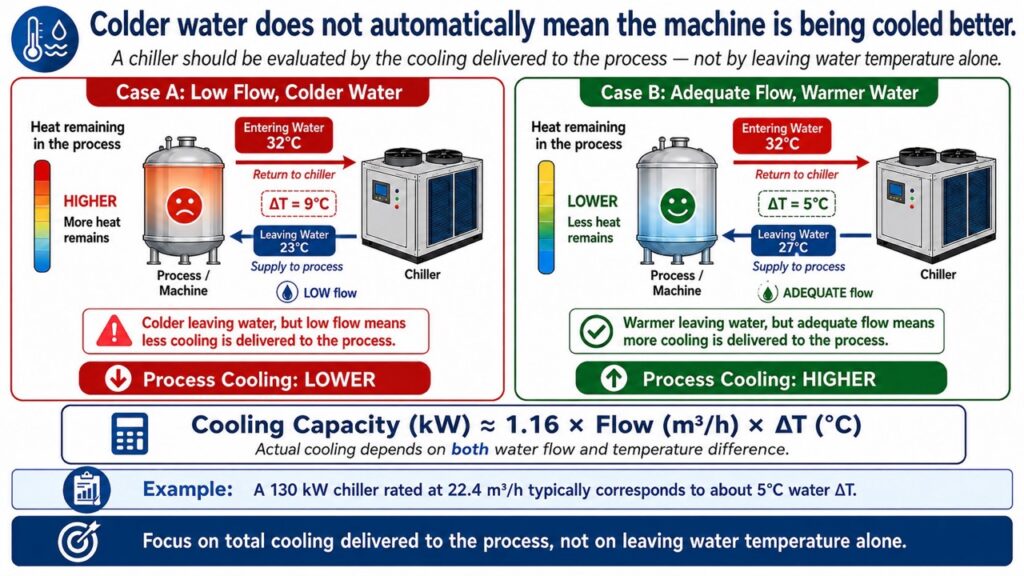
Higher flow:
32°C entering water → 27°C leaving water
Reduced flow:
32°C entering water → 23°C leaving water
The second example appears much better because the leaving water is colder.
But this does not necessarily mean more heat has been removed.
If the flow rate has been significantly reduced, the total cooling capacity delivered to the process may remain the same — or could even become less useful to the process.
For machine cooling, the objective should therefore not be simply:
“How can we make the chilled water colder?”
The more important question is:
“How much heat must be continuously removed from the machine or process?”
A Real Process Cooling Example
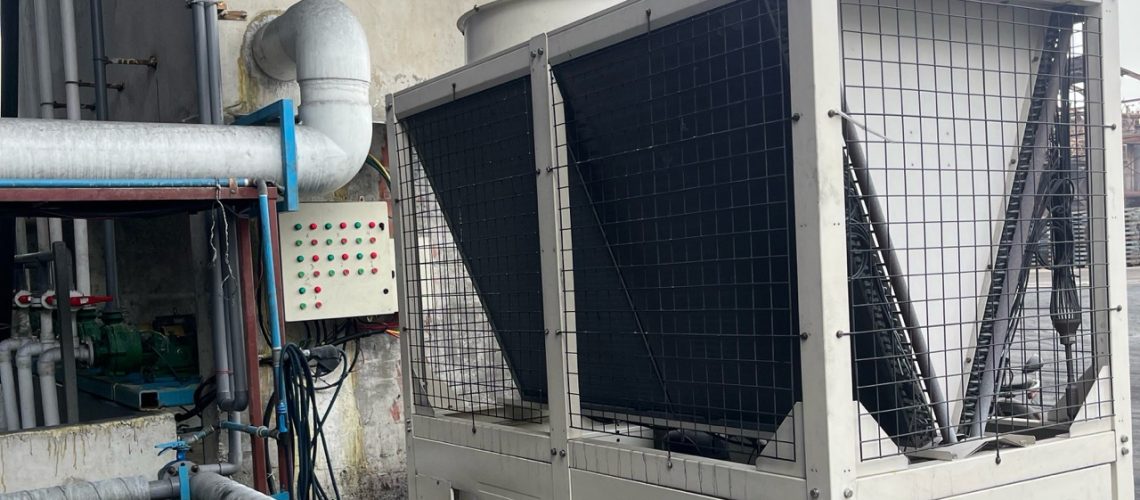
During a recent site inspection, we encountered an air-cooled process chiller used to cool an industrial electrolysis process.
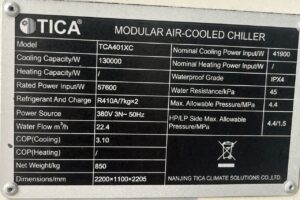
The chiller had:
- Nominal cooling capacity: approximately 130 kW
- Rated chilled-water flow: 22.4 m³/h
- Chilled-water setpoint: 7°C
During operation, the chiller controller showed approximately:
- Entering Water Temperature (EWT): 32°C
- Leaving Water Temperature (LWT): 23°C
This represents a temperature difference of approximately 9°C.
At first glance, a 9°C temperature reduction might appear to indicate strong cooling performance.
However, the chiller’s rated flow and cooling capacity correspond to a much smaller design temperature difference of roughly 5°C.
Without measuring the actual water flow, the 9°C ΔT cannot be used to determine the actual cooling capacity.
One possible explanation for the larger temperature difference is that the actual water flow is considerably lower than the chiller’s rated flow.
Why Process Heat Load Matters More
The chilled water at this site was being used to remove heat from an electrolysis process.
According to the operator, the water could return from the process at above 40°C when recirculated.
Under those conditions, the existing chiller was unable to bring the water anywhere near its 7°C setpoint.
This indicates an important distinction between water temperature and total process heat load.
If a production process continuously generates more heat than the chiller can remove, the water temperature will eventually rise regardless of the setpoint entered into the chiller controller.
A buffer tank may slow down the temperature increase, but it cannot solve a continuous shortage of cooling capacity.
The cooling system must ultimately be capable of rejecting heat at the same rate that the process generates it.
A Larger ΔT Is Not Always Better
A large chilled-water ΔT can sometimes be desirable when the system has been designed specifically for it.
But an unexpectedly large ΔT can also indicate:
- insufficient water flow;
- partially closed valves or restrictions;
- pump performance problems;
- unbalanced water circuits; or
- operating conditions significantly different from the original design.
Likewise, a small ΔT does not automatically mean the chiller is performing poorly. High water flow can naturally result in a smaller temperature difference while still transferring a large amount of heat.
This is why temperature measurements should never be interpreted without understanding water flow.
How Should an Industrial Chiller Be Evaluated?
For process cooling applications, a proper assessment should ideally include:
- chilled-water flow rate;
- entering and leaving chilled-water temperatures;
- process water temperature before and after the heat source;
- actual process operating load;
- chiller compressor operating condition;
- condenser condition and ambient temperature; and
- required process operating temperature.
Once water flow and temperature difference are known, the actual process cooling load can be estimated and compared with the available chiller capacity.
Without these measurements, selecting a replacement chiller based purely on water temperature becomes guesswork.
For more information on industrial process cooling equipment, see our industrial chiller solutions.
The Key Takeaway
A chiller should not be judged simply by how cold its leaving water becomes.
For industrial process cooling, the real question is:
How much heat can the complete cooling system continuously remove from the process?
Lowering water flow to achieve a colder leaving-water temperature may make the temperature reading look better, but it does not create additional refrigeration capacity.
A properly designed system must consider process heat load, chilled-water flow, temperature difference and chiller capacity together.
Before increasing chiller capacity or changing operating temperatures, the actual process cooling requirement should first be understood.