

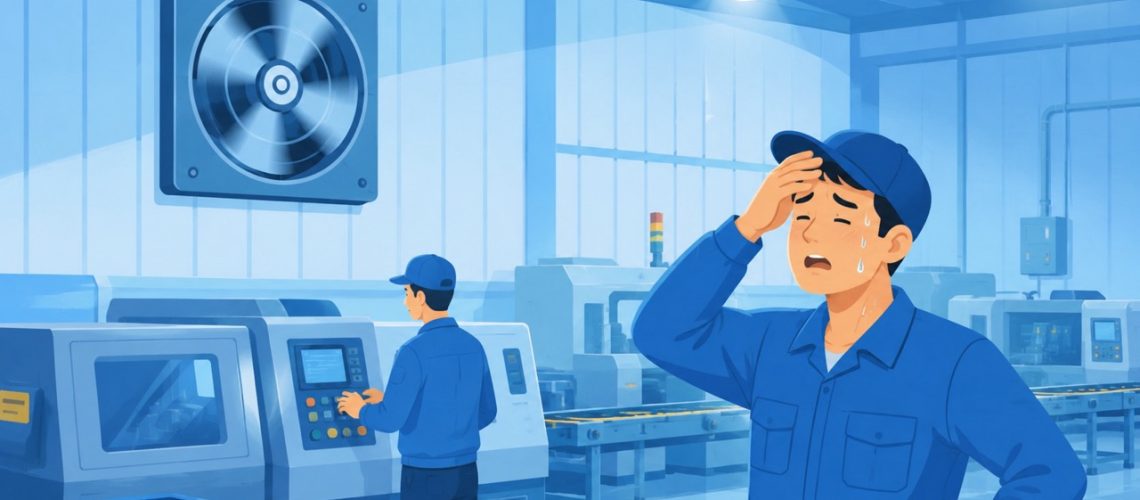
One of the most common mistakes is installing an exhaust fan in a completely closed space. For example, the door is closed, the windows are closed, or the room has no suitable opening for fresh air to enter.
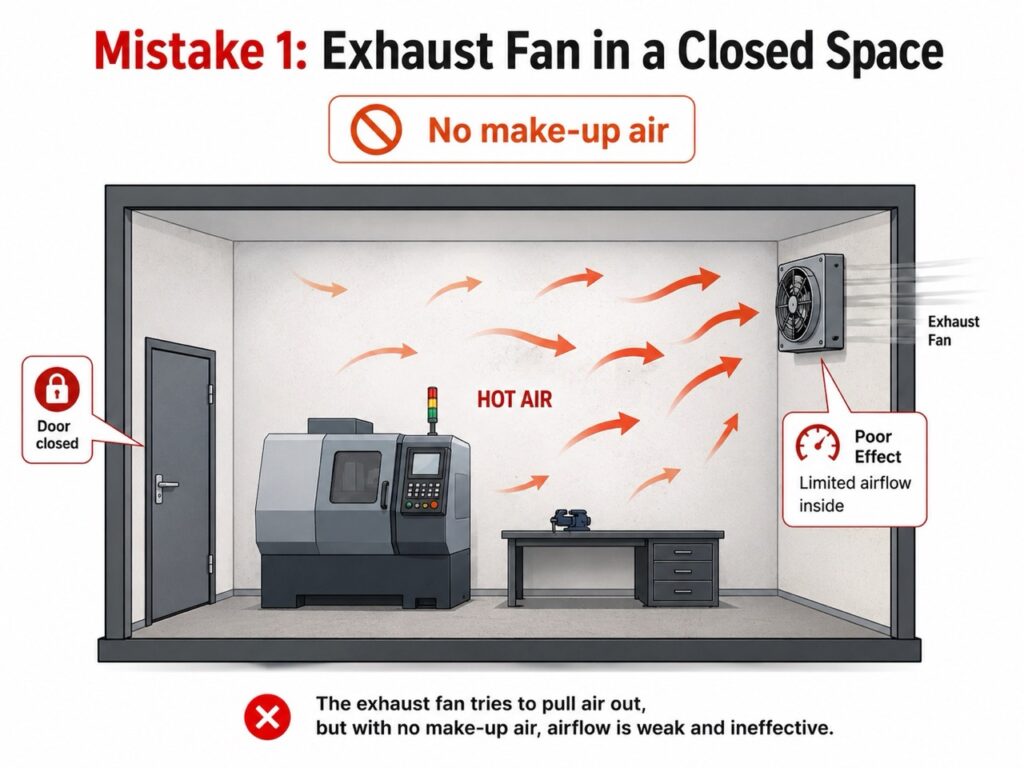
When the exhaust fan starts running, it tries to remove air from the room. However, if there is no make-up air coming in, the fan cannot move much air. The room may become slightly negative pressure, but the actual airflow becomes weak.
This is why some owners feel that the exhaust fan has “no suction” even though the fan is working. The fan is not the only problem. The space itself does not allow air to enter and replace the air being extracted.
For an exhaust fan to work properly, there must be a proper air inlet. Fresh air should enter from the opposite side or from a suitable opening, pass through the working area, and then exit through the exhaust fan. Without this airflow path, the fan may run continuously but still fail to remove heat, smell or stale air effectively.
The same principle also applies to restaurant kitchens, where a kitchen exhaust hood may perform poorly if there is not enough make-up air or fresh air supply.
Another common mistake is hanging an exhaust fan in open air without any surrounding wall, panel or proper enclosure. This sometimes happens when a worker hangs a fan near the ceiling or at a convenient structure and expects it to remove hot air from the whole area.
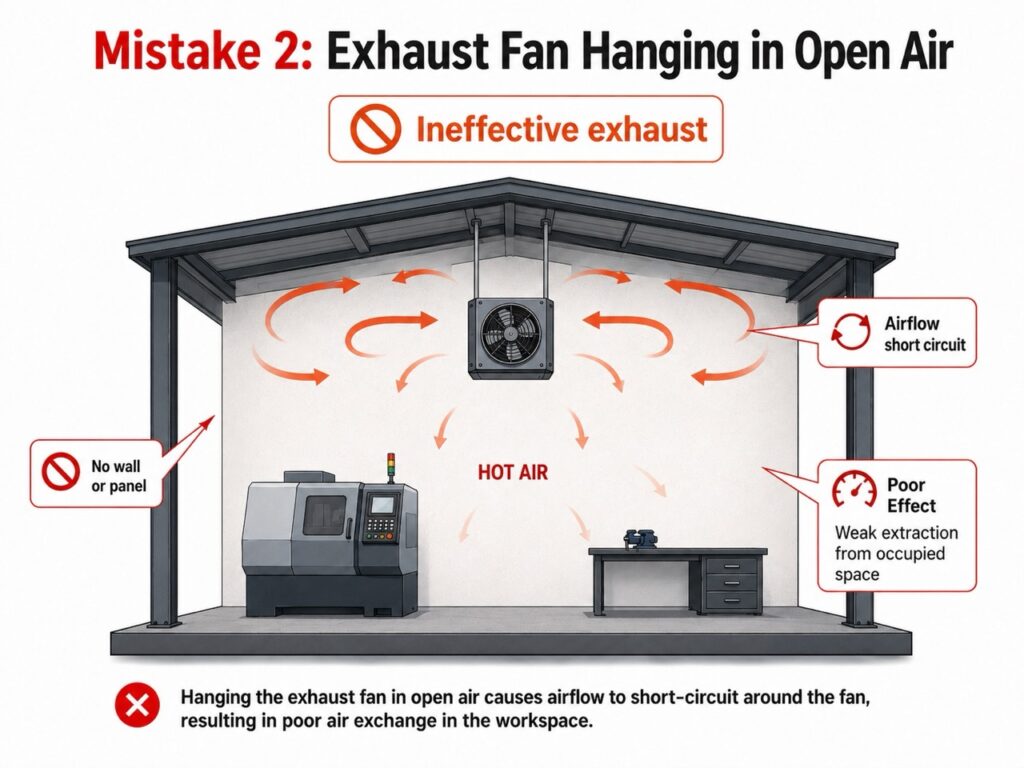
The problem is airflow short circuit. If the fan is not mounted on a proper wall opening or panel, the air may be sucked from the nearby side or back area and discharged again nearby. Instead of pulling hot air from the intended room or production floor, the fan is only circulating air around itself.
An exhaust fan should normally be mounted on a proper wall opening, duct opening, roof opening or fabricated panel. The surrounding area should prevent air from bypassing the fan. This forces the air to move through the fan from the intended space to the outside discharge area.
This is especially important for factory heat extraction. If the fan is simply hanging in the air, it may create noise and air movement nearby, but it may not remove the hot air from the actual problem area.
Some exhaust fans are installed directly on louver grilles, wire mesh or netting. This may look convenient, but it can make the exhaust fan much less effective if the fan is not properly mounted on a sealed wall opening or proper frame.
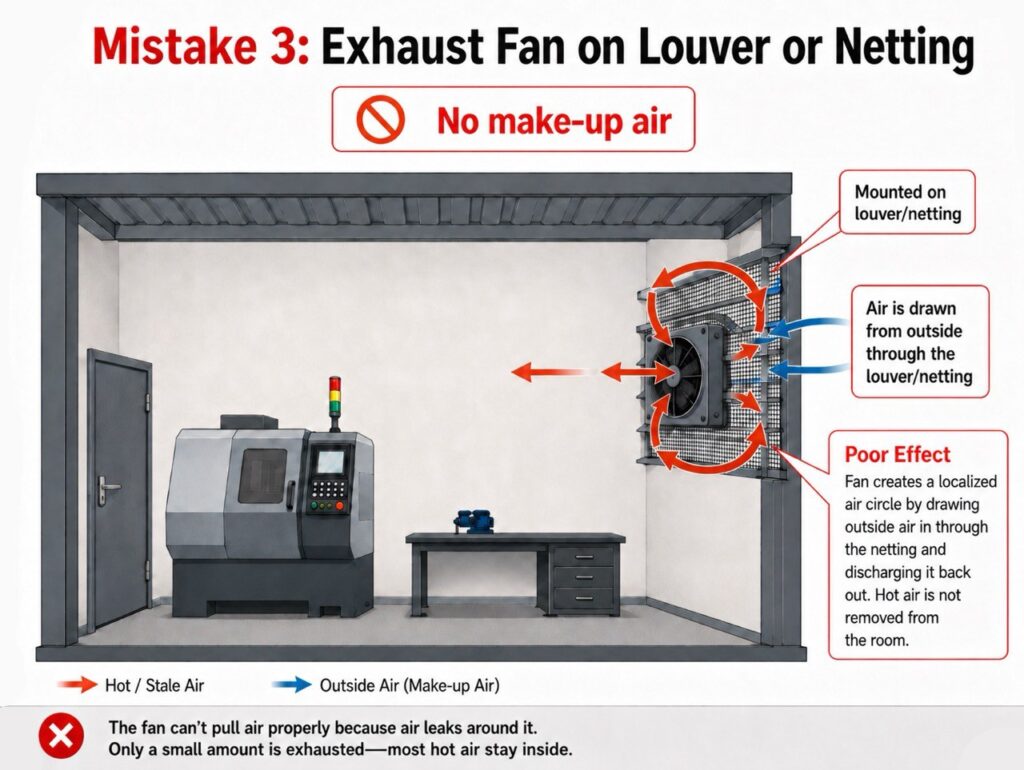
The main problem is localized airflow short circuit. Instead of pulling hot air from the room or production area, the fan may keep drawing air from outside through the surrounding louver or netting area, then discharge the same air back outside again. This creates a small local air circle around the fan.
When this happens, the exhaust fan is running, but it is not properly extracting the hot air from inside the space. The air movement is mostly happening around the fan and nearby louver/netting area, while the actual hot air inside the room remains trapped.
For better performance, the exhaust fan should be mounted on a proper wall opening with a suitable frame or panel. The surrounding area should be sealed properly so the fan is forced to pull air from the intended room or work area, not from the nearby outside opening.
This is why choosing the correct Industrial exhaust fan is only one part of the solution. The mounting method, opening size and airflow path are equally important.
This mistake is very common in shoplots, restaurants, toilets, dining areas and small kitchens. A ceiling exhaust fan is installed on a plaster ceiling, but nobody checks where the air will actually discharge.
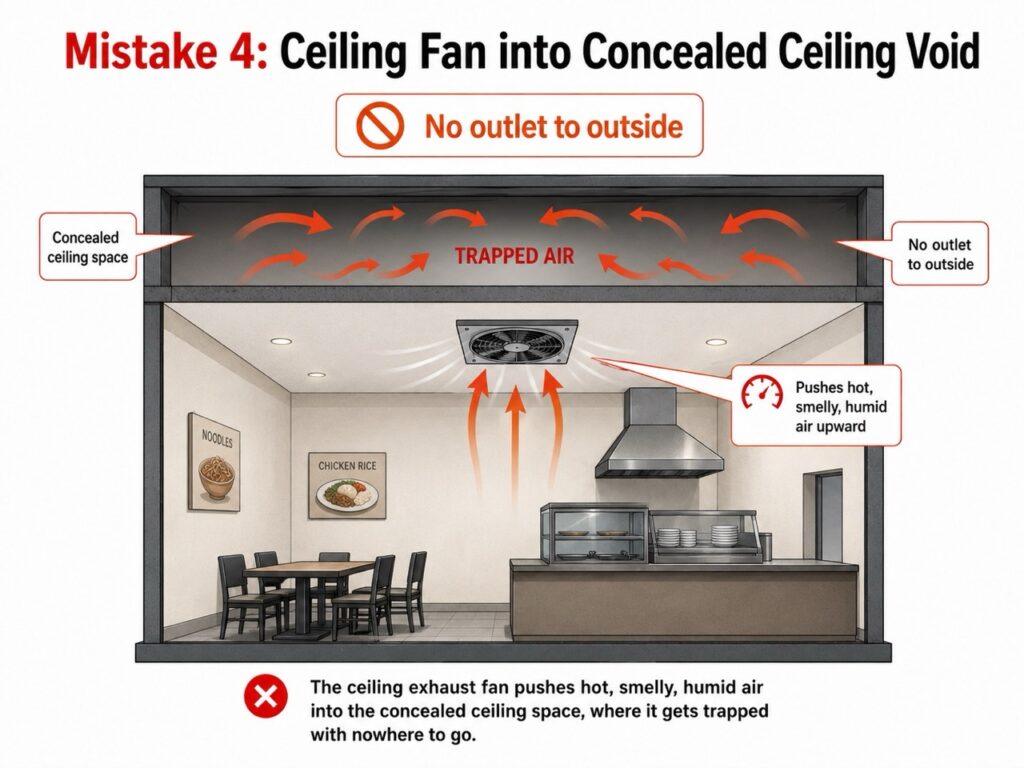
If the space above the plaster ceiling is totally concealed, the exhaust fan only pushes air into the ceiling void. The fan may be running, but the hot air, smell or humid air has nowhere to go. It is not being discharged to the outside of the building.
In this situation, the room may still feel hot, stuffy or smelly even after the exhaust fan is installed. The ceiling space becomes a trapped air chamber. The air is only moved from the room into the concealed ceiling space, not out of the building.
A proper ceiling exhaust fan installation must have a clear discharge path. The air should be ducted to the outside, or the ceiling void should have a proper external discharge opening. In some cases, an opening may need to be made on the external wall above the ceiling level to allow the trapped air to move outside.
For kitchen areas with cooking fumes, this must be handled more carefully. Grease, smoke and hot air should not be discharged freely into a concealed ceiling space. For commercial cooking areas, a proper Commercial kitchen exhaust hood system is usually required to remove smoke, heat and grease-laden air properly.
Many factories in Malaysia are later extended at the side or back with additional roofing, wall cladding or covered working space. After the extension is added, the original external wall may no longer be the true outside wall of the building.
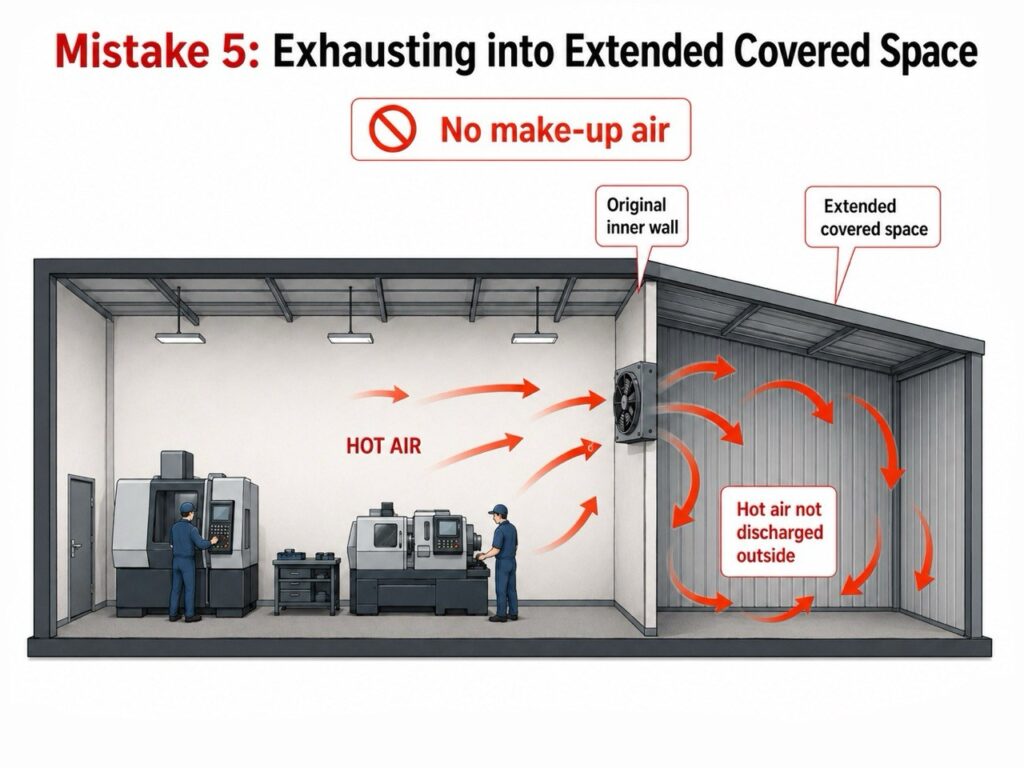
A common mistake is leaving the exhaust fans on the original inner wall. The fan may still be running, but it is no longer discharging hot air directly to the outside. Instead, it only moves hot air from the production floor into the newly extended covered area.
When this happens, the exhaust fan does not solve the heat problem. It only transfers hot air from one area to another. The extended space may become hot and stuffy, and the hot air may even flow back into the factory if there is no proper final discharge path.
For exhaust fans to work effectively, the discharged air must have a clear route to the outside atmosphere. If the factory has been extended, the exhaust system may need to be relocated to the new external wall, connected with ducting, or supported with additional exhaust fans at the final discharge point.
This is why factory extensions should always be reviewed together with the existing ventilation system. Once the building layout changes, the airflow path also changes. An exhaust fan position that worked before may become ineffective after the factory is extended.
Some exhaust fans are installed at the easiest location, not the most effective location. For example, the fan may be installed where the wall is easy to cut, where there is nearby electrical supply, or where the installation worker feels it is convenient.
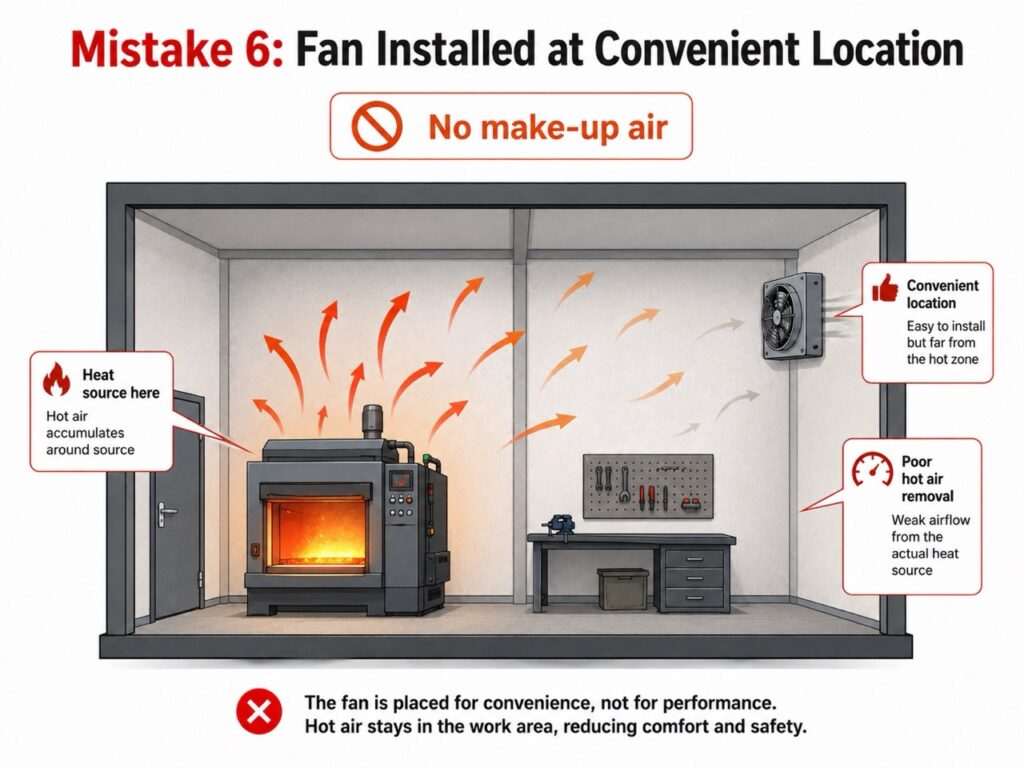
However, the hottest area may be somewhere else. Heat usually accumulates near machines, ovens, compressors, production lines, roof spaces or stagnant corners. If the exhaust fan is too far from the heat source or not aligned with the airflow direction, it may not remove the actual hot air effectively.
A better approach is to identify where the heat is generated, where the hot air accumulates, where fresh air can enter, and where the air should discharge. The exhaust fan should support this airflow path, not fight against it.
Good ventilation is not just about installing more fans. The airflow direction must be planned. Ideally, fresh air should enter from one side, pass through the occupied or production area, and discharge through the exhaust fan on the other side or at the hot-air accumulation area.
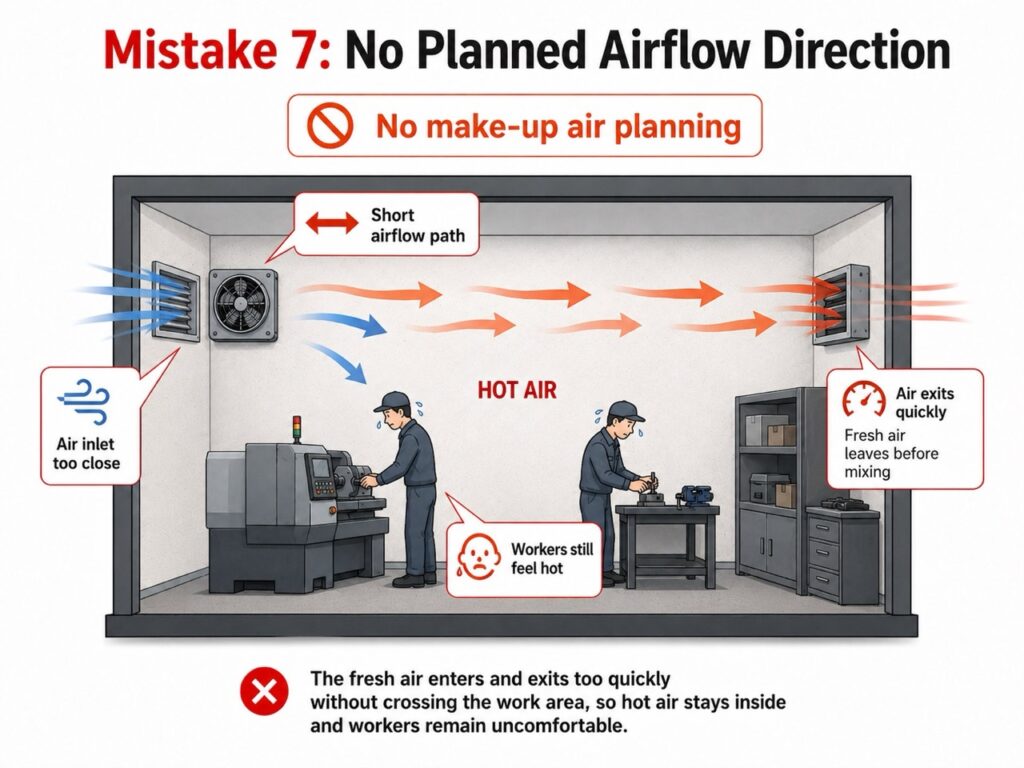
If the air inlet and exhaust fan are too close to each other, the air may short circuit. This means fresh air enters and exits quickly without passing through the actual working area. The fan may be moving air, but the workers still feel hot because the airflow does not reach them.
For larger factories, exhaust fan design may need to be combined with fresh air supply, ducting, air coolers or other ventilation methods. If the objective is not only to remove hot air but also to improve worker comfort, the system should be planned as a complete airflow solution instead of only adding exhaust fans at random locations.