

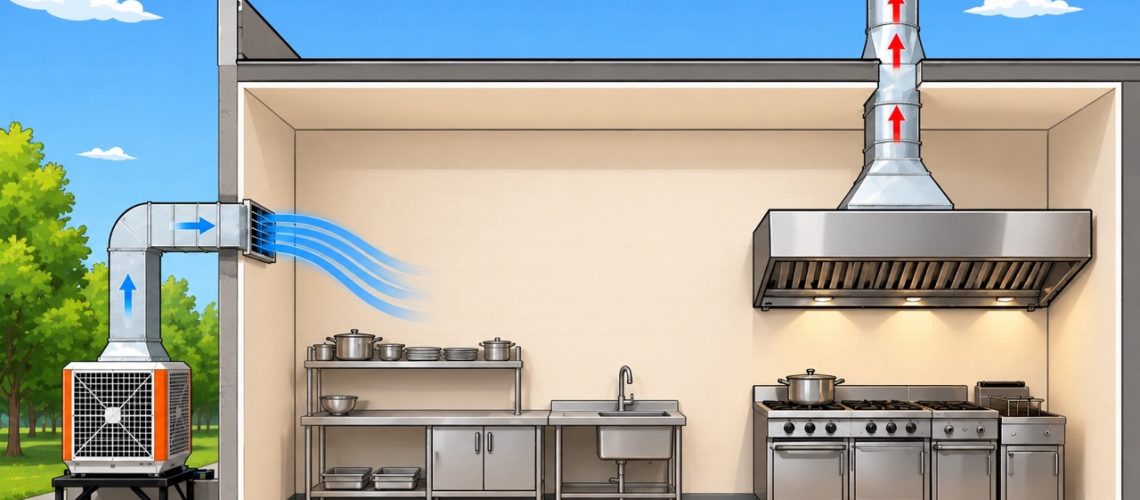
A commercial kitchen exhaust hood is designed to remove smoke, heat, grease vapour and cooking fumes from the kitchen. However, many restaurant owners only focus on the exhaust hood and exhaust fan, but overlook one important part of the system: make-up air.
In simple terms, make-up air means the fresh air that enters the kitchen to replace the air being exhausted out.
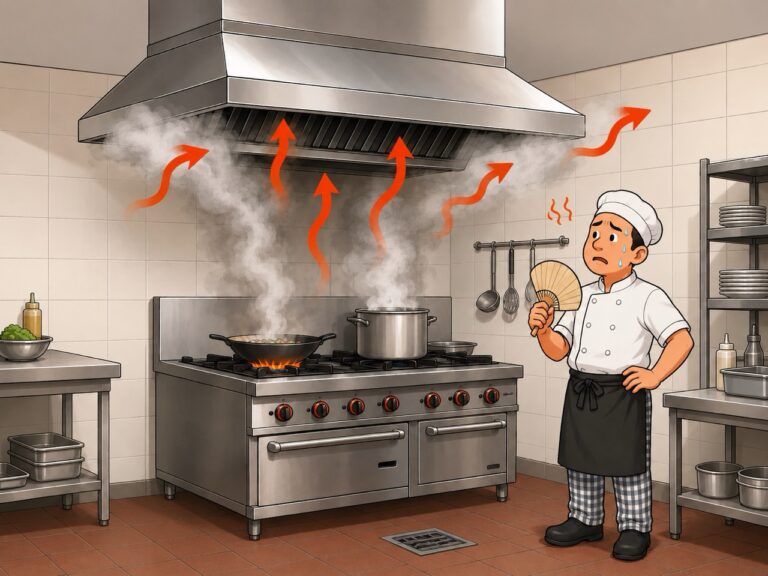
When an exhaust fan removes air from the kitchen, that air must come from somewhere. If the kitchen does not have enough incoming air, the exhaust hood may not perform properly even if the fan is running. This can cause the kitchen to feel smoky, hot, stuffy, and uncomfortable for the workers.
For cafes, restaurants, cloud kitchens, food courts and commercial kitchens in Malaysia, make-up air is an important part of a proper kitchen exhaust system design.
What Is Make-Up Air in a Kitchen Exhaust System?
Make-up air is the replacement air supplied into a kitchen after the exhaust system removes air from the space.
For example, when a kitchen exhaust fan pulls smoke and hot air out through the exhaust hood, ducting and exhaust fan, the same amount of air needs to be replaced naturally or mechanically. This replacement air may come from door openings, wall louvers, fresh air grilles, or a dedicated fresh air fan system.
Without enough make-up air, the kitchen becomes negatively pressured. This means the exhaust fan is trying to remove air from a space that does not have enough air coming back in.
When this happens, the exhaust hood may look like it is operating, but the actual smoke capture can become weak.
Why Exhaust Hood Performance Depends on Replacement Air
A kitchen exhaust system is not only about removing air. It is about creating a proper airflow path.
The exhaust hood pulls smoke and heat upward from the cooking area. The ducting carries the contaminated air away. The exhaust fan discharges it outside the building. But for this airflow to continue smoothly, fresh air must enter the kitchen to replace the exhausted air.
If there is not enough replacement air, the exhaust fan has to work harder. Air may start entering through random gaps, door cracks, ceiling openings or even from the dining area. This can create unstable airflow inside the kitchen.
In some cases, restaurant owners may think the exhaust fan is too small. But the real issue may not be the fan size. The problem could be that the kitchen does not have enough make-up air. For a complete setup, the commercial kitchen exhaust hood system should be planned together with the hood size, ducting route, exhaust fan capacity and fresh air supply path.
This is why simply upgrading to a bigger exhaust fan is not always the correct solution. If the air supply is still insufficient, the system may continue to perform poorly.
Common Signs Your Kitchen Does Not Have Enough Make-Up Air
A commercial kitchen may have insufficient make-up air if you notice problems such as:
- The kitchen still feels smoky even when the exhaust hood is running
- Smoke escapes from the front or side of the exhaust hood
- The kitchen feels very hot and stuffy
- Cooking smell spreads into the dining area
- Doors become difficult to open or close
- Air rushes in strongly when a door is opened
- The exhaust fan sounds powerful, but smoke capture feels weak
- Air-conditioning in the restaurant becomes less effective
- Workers feel uncomfortable near the cooking line
These symptoms may happen because the exhaust system is pulling out more air than the kitchen can properly replace.
What Happens When a Kitchen Has Negative Pressure?
Negative pressure happens when more air is being exhausted out than supplied in.
In a commercial kitchen, negative pressure can create several problems. The exhaust hood may not capture smoke smoothly because the room is struggling to receive enough replacement air. Air may enter from uncontrolled areas, creating turbulence around the cooking area.
This turbulence can disturb the smoke path and push fumes away from the hood opening. As a result, smoke may spill into the kitchen instead of being pulled into the hood.
Negative pressure can also pull air from unwanted areas, such as toilets, back lanes, ceiling voids or dining areas. This may affect comfort, odour control and overall hygiene.
For air-conditioned restaurants, the problem can become more noticeable. If the kitchen exhaust system pulls too much air without proper make-up air planning, conditioned air from the dining area may be pulled into the kitchen and discharged outside. This increases cooling load and makes the air-conditioning less effective.
Does Every Kitchen Need a Dedicated Make-Up Air System?
Not every small kitchen needs a dedicated make-up air fan.
Some kitchens may already have enough natural air openings, wall louvers, back doors, or open layouts that allow sufficient replacement air to enter. For small and simple cooking setups, natural air supply may be enough if the exhaust volume is not too high.
However, make-up air should be considered more carefully for:
- Enclosed commercial kitchens
- Air-conditioned restaurants
- Long cooking lines
- Heavy cooking such as wok cooking, frying or grilling
- Kitchens with high-capacity exhaust fans
- Kitchens where smoke still escapes from the hood
- Restaurants where cooking smell spreads into the dining area
- Kitchens with long ducting routes or multiple exhaust hoods
In these situations, a properly planned fresh air supply can improve the performance of the kitchen exhaust hood and create a more comfortable working environment.
For a broader overview of hood design, ducting, exhaust fans and airflow planning, you can also refer to our commercial kitchen exhaust ventilation guide.
Simple Ways to Provide Make-Up Air
There are several ways to provide make-up air for a commercial kitchen. The correct method depends on the kitchen layout, cooking load, exhaust airflow, building design and available space.
One common method is to install wall louvers or fresh air openings. This allows outdoor air to enter the kitchen naturally when the exhaust fan is running. This method is simple, but it may not be suitable for all kitchens, especially if the kitchen is fully enclosed or air-conditioned.
Another method is to use a fresh air fan to supply air into the kitchen. This gives better control over the incoming air volume and direction. The fresh air can be supplied through grilles, ducting or air distribution points.
For larger kitchens, a more complete design may include both exhaust and fresh air ducting. This allows the exhaust system and make-up air system to work together as a balanced airflow system.
However, the fresh air should not be supplied directly in a way that disturbs the exhaust hood. If air is blown too strongly across the cooking area, it can push smoke away from the hood and make the exhaust performance worse.
The goal is not just to bring in air. The goal is to bring in air in the correct amount, correct location and correct direction.
Why Bigger Exhaust Fan Is Not Always the Answer
When a kitchen is smoky, many restaurant owners immediately assume that the exhaust fan is too small.
Sometimes this is true. The fan may be undersized, the ducting may be too long, or the hood may not be designed properly. But in many cases, the exhaust fan is only one part of the issue.
If the kitchen does not have enough make-up air, installing a bigger exhaust fan may create even stronger negative pressure. This can make the kitchen pull air from unwanted areas and increase discomfort.
A bigger fan may also create more noise, higher power consumption and stronger air imbalance. If the ducting size is not suitable, the fan upgrade may not deliver the expected improvement. This is similar to many factory ventilation cases where exhaust fans are not always effective when the air movement path is not properly planned.
Before changing the exhaust fan, it is better to check the full system:
- Exhaust hood size and position
- Ducting size and route
- Number of ducting bends
- Exhaust fan capacity
- Grease filter condition
- Fresh air supply path
- Kitchen pressure condition
- Cooking equipment layout
A proper kitchen exhaust system should be designed as a complete airflow system, not only as an exhaust fan installation.
Make-Up Air and Air-Conditioned Restaurants
Make-up air is especially important for air-conditioned restaurants.
In many cafes and restaurants, the kitchen is connected to the dining area. When the kitchen exhaust system runs, it removes a large amount of air from the building. If there is no proper fresh air supply for the kitchen, the system may pull cold air from the dining area.
This can cause several problems. The dining area may become warmer, the air-conditioning system may work harder, and cooking smell may move into customer areas. The entrance door may also feel like it has strong suction when opened.
For air-conditioned premises, the make-up air design should be planned carefully. The objective is to support the kitchen exhaust system without wasting too much cooled air from the dining space.
In some projects, a simple fresh air opening may be enough. In other cases, a dedicated make-up air fan or fresh air ducting system may be needed.
Common Mistakes in Kitchen Make-Up Air Design
A poor make-up air arrangement can also create problems.
One common mistake is supplying fresh air too close to the cooking hood at high speed. This may disturb the smoke rising from the cooking equipment and cause smoke to escape from the hood.
Another mistake is relying only on small gaps or door openings for a high-volume exhaust system. This may not provide stable airflow, especially during peak cooking hours.
Some kitchens also install powerful exhaust fans without considering where the replacement air will come from. The result is a noisy fan, strong suction, hot kitchen, and poor smoke control.
A good make-up air design should support the exhaust hood, not fight against it.
When Should You Check Your Kitchen Make-Up Air?
You should check your kitchen make-up air if your exhaust hood is already installed but the kitchen still has smoke, heat or smell problems.
It is also important to check before renovation or layout changes. If you are relocating cooking equipment, extending ducting, adding more cooking appliances or upgrading the exhaust fan, the make-up air requirement may change.
For new restaurant setup, make-up air should be considered during the design stage together with the kitchen exhaust hood, ducting and exhaust fan. This helps avoid costly modification work after the kitchen is already operating.
Conclusion
A kitchen exhaust hood needs proper make-up air to work effectively.
Without enough fresh air supply, the exhaust fan may struggle to remove smoke and heat properly. The kitchen can become negatively pressured, smoky, hot and uncomfortable. In some cases, cooking smell may spread into the dining area or the air-conditioning may become less effective.
For a good commercial kitchen exhaust system, the exhaust hood, ducting, exhaust fan and make-up air should be considered together.
If your restaurant, cafe or commercial kitchen still feels smoky or hot even after installing an exhaust hood, the issue may not be only the exhaust fan. It may be time to check whether your kitchen has enough make-up air.
CrystalAir provides commercial kitchen exhaust hood system assessment, installation and modification services for restaurants, cafes and commercial kitchens in Malaysia. If you are planning a new kitchen setup, renovation or exhaust system upgrade, we can help check the hood, ducting, exhaust fan and fresh air supply arrangement for a more practical kitchen ventilation solution.
You can also view some of our recent kitchen exhaust projects to see examples of hood, ducting and exhaust system work completed for commercial kitchens.