
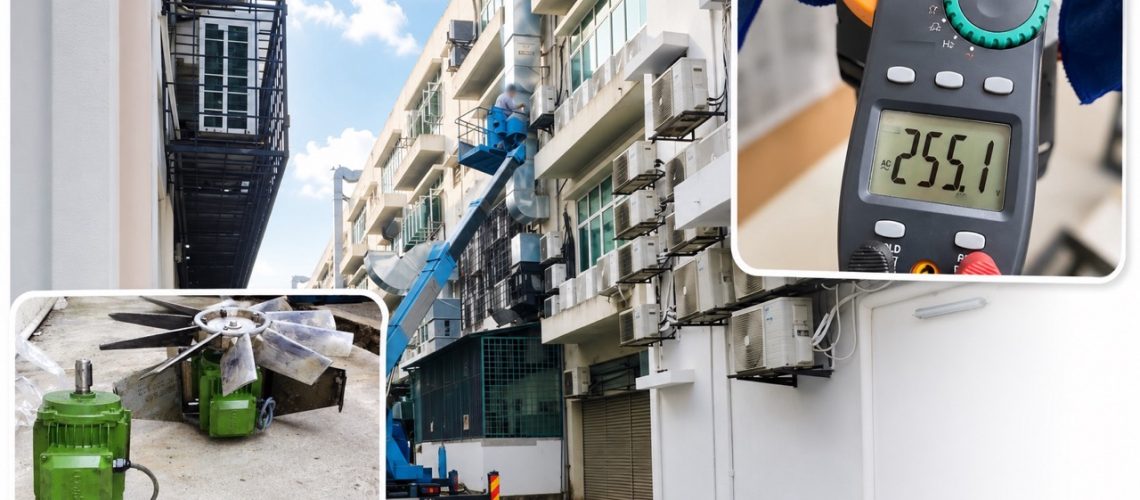
An existing restaurant client contacted CrystalAir after its kitchen exhaust fan system began tripping the MCB whenever the motor starter was switched on. The commercial kitchen exhaust hood system was installed by CrystalAir approximately four months earlier and was still under warranty.
Project Snapshot
Project Type: Under-warranty exhaust fan troubleshooting
Initial Complaint: MCB tripped when the exhaust fan starter was switched on
System Age: Approximately four months
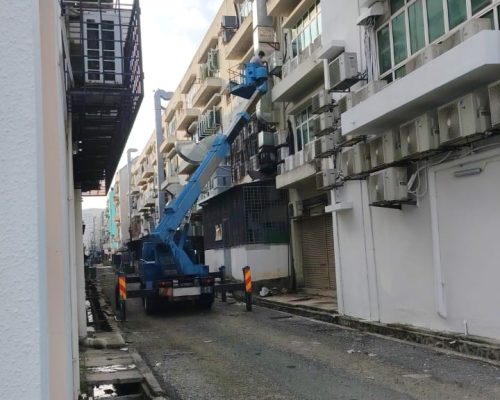
Access Method: Skylift
Work Carried Out: Exhaust fan motor replacement and electrical checking
Important Finding: One phase-to-neutral voltage reading reached approximately 255.1V
The Challenge
The customer informed us that their electrician had already checked the electrical supply and found no issue.
Our technician then carried out troubleshooting from the starter panel and confirmed that the fault appeared to be related to the exhaust fan motor. However, the exact cause could not be confirmed without physically accessing and removing the motor.
Since skylift rental is charged by the day, arranging one visit only for inspection could result in another skylift rental for the actual replacement.
Our Recommended Approach
We recommended preparing a replacement motor before arranging the skylift. This allowed us to access the fan, replace the suspected faulty motor and bring the removed motor back for further inspection during the same visit.
Although the exhaust system was still under warranty, the special access cost for the skylift was not included under the standard warranty coverage. The customer understood the site condition and agreed to bear the skylift rental cost.
Motor Replacement and Final Checking
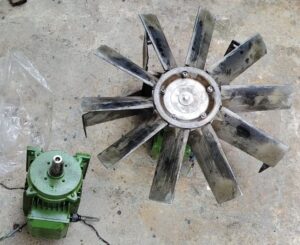
The motor was successfully replaced, and the removed motor and impeller were brought down for further inspection.
Before commissioning the replacement motor, our technician carried out another incoming voltage check at the starter panel.
The recorded readings were approximately:
- Red phase: 238V
- Yellow phase: 254–255V
- Blue phase: 248V
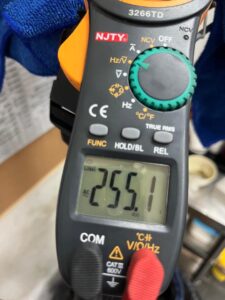
Because the 254–255VV reading was slightly above the normal upper limit of 253V stated by TNB for a nominal 230V supply, we advised the customer not to operate the exhaust fan and to escalate the incoming power supply issue to their electrician, building management and TNB.
Watch the Troubleshooting Process
The short video below shows the actual site access, exhaust fan motor replacement and final voltage checking carried out before commissioning.
The Key Finding
The customer later informed us that TNB work had been carried out in the area before the exhaust fan motor breakdown. They also reported that tenants on both the lower and upper floors had experienced unexplained electrical appliance failures afterward.
This further supported the possibility that the problem was related to the building’s incoming power supply rather than the kitchen exhaust ventilation system alone.
Although the abnormal voltage reading could not by itself conclusively prove the cause of the original motor failure, it was sufficient reason to stop commissioning and recommend further investigation.
The Result
The replacement motor was installed, but the system was not immediately commissioned because of the abnormal incoming voltage.
By carrying out one final electrical check before handover, CrystalAir helped prevent the replacement motor from being exposed to the same possible risk.
This case shows why proper troubleshooting should not stop after replacing a faulty component. The cause of the failure must also be investigated to reduce the risk of repeated breakdowns. Following the investigation, the motor replacement was not approved as a warranty claim because the abnormal incoming power supply condition was outside the scope of the equipment warranty.
For other examples of poor installation and system problems, see our guide to common kitchen exhaust hood installation problems.
Need Help With a Kitchen Exhaust Fan Breakdown?
CrystalAir provides commercial kitchen exhaust fan troubleshooting, motor replacement, ducting works and complete kitchen exhaust hood system installation for restaurants and commercial kitchens in Malaysia.