
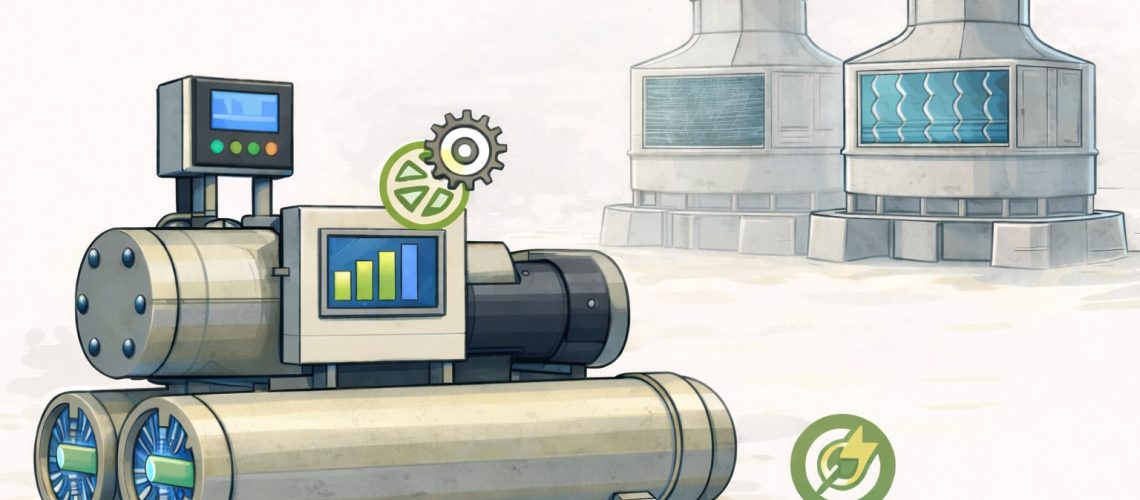
Rising electricity costs in Malaysia have made chiller efficiency a top concern for facility managers. Yet many plants assume that significant efficiency gains require full chiller replacement.
In reality, many existing water-cooled chillers still have recoverable efficiency — if the right optimisation strategies are applied.
This guide explains how to improve chiller efficiency in existing industrial plants, focusing on practical actions that deliver measurable results.
Why Many Older Chillers Are Still Recoverable
Chillers rarely become inefficient overnight.
Efficiency loss usually happens gradually due to:
Fouled heat exchangers
Degraded bearings and seals
Poor water quality
Control system drift
Suboptimal operating practices
Before replacement is considered, efficiency recovery should be evaluated.
Related reading:
Chiller Overhaul vs Replacement: Which Is More Cost-Effective in Malaysia?
Common Efficiency Killers in Water-Cooled Chillers
- Heat Exchanger Fouling
Even light scaling or biofouling increases approach temperatures, forcing compressors to work harder.
Supporting article:
The Importance of Water Treatment for Chilled Water Systems.
- Mechanical Wear
Worn bearings, seals, and impellers increase internal losses and reduce compression efficiency.
Related article:
What Happens During a Professional Chiller Overhaul? A Step-by-Step Guide
- Poor Condenser Performance
Cooling tower inefficiencies directly increase chiller power consumption.
- Control & Sensor Drift
Inaccurate sensors lead to incorrect loading, short cycling, and poor part-load performance.
Mechanical Improvements That Recover Efficiency
Heat Exchanger Restoration
- Tube brushing or chemical cleaning
- Retubing for severely degraded bundles
- Tube material upgrades (where applicable)
These actions often deliver immediate efficiency improvement.
Bearing & Seal Restoration
- Reduces friction losses
- Improves compressor stability
- Lowers oil contamination risk
This is especially critical for centrifugal chillers.
Related comparison:
Centrifugal vs Screw Chillers: Maintenance, Efficiency & Lifecycle Comparison
Control & Operational Optimisation
Chilled Water Temperature Reset
Many systems operate at unnecessarily low setpoints, increasing compressor lift.
Condenser Water Optimisation
Optimising condenser water temperature improves chiller efficiency but must be balanced against cooling tower performance.
Guidelines from ASHRAE highlight the importance of integrated system optimisation rather than isolated adjustments.
Load Management
Operating chillers closer to their optimal efficiency range often yields significant energy savings.
Cooling Tower & Water Quality Impact
Cooling tower performance directly affects chiller efficiency.
Key factors include:
- Proper airflow
- Clean fill media
- Balanced water distribution
- Effective water treatment
The International Energy Agency consistently identifies heat rejection efficiency as a critical contributor to HVAC energy consumption.
When Optimisation Is No Longer Enough
Optimisation may no longer be cost-effective when:
- Structural components are degraded
- Refrigerant is obsolete
- Efficiency recovery is marginal
- Failure risk outweighs savings
At this stage, overhaul or replacement evaluation is necessary.
Supporting article:
Chiller Preventive Maintenance Checklist for Facility Managers
A Practical Efficiency Improvement Checklist
Before replacing a chiller, confirm whether:
- Heat exchangers are clean and efficient
- Bearings and seals are within tolerance
- Sensors and controls are calibrated
- Cooling tower performance is optimised
- Operating setpoints are justified
Many facilities recover 5–20% energy savings through optimisation alone.
Conclusion: Efficiency Improvement Is Often the First Best Step
Replacing a chiller is a major investment.
Improving efficiency in existing systems is often:
- Faster
- Less disruptive
- More cost-effective
A structured optimisation approach helps facility managers reduce energy cost, extend chiller life, and delay capital expenditure. It is highly-recommended for facility managers to have a full understanding of the complete chiller maintenance knowledge before improving the efficiency of a chiller.