
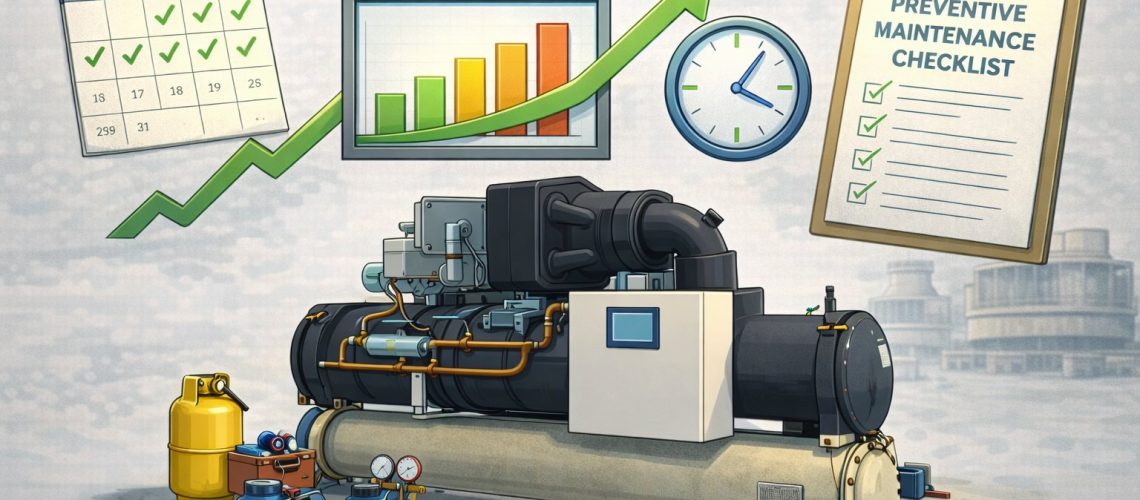
Industrial water-cooled chillers are long-term capital assets. With proper design operation and disciplined maintenance, it is realistic for a chiller to operate 15–25 years, and in some cases even longer.
However, many chillers fail prematurely—not because of poor manufacturing, but due to avoidable operational and maintenance issues.
This guide explains what truly determines chiller lifespan, the most common mistakes that shorten it, and the proven strategies facility managers can implement to extend chiller life well beyond expectations.
What Is the Expected Lifespan of an Industrial Chiller?
In real-world commercial and industrial applications:
- Air-cooled chillers: 10–15 years
- Water-cooled chillers: 15–25 years
- Well-maintained water-cooled chillers: 25–30 years (with overhaul)
Water-cooled chillers last longer because:
- They operate at lower condensing temperatures
- Compressor stress is significantly reduced
- Heat rejection is more stable when cooling towers are well maintained
This makes maintenance quality more important than brand or model.
1. Preventive Maintenance Is the #1 Lifespan Factor
Reactive maintenance is the fastest way to destroy a chiller.
A structured preventive maintenance program:
- Reduces mechanical wear
- Prevents oil contamination
- Detects efficiency loss early
- Avoids catastrophic compressor failure
At minimum, every facility should follow a formal preventive maintenance checklist covering:
- Compressor condition
- Oil system health
- Heat exchanger cleanliness
- Safety controls and sensors
Related Reading :
Chiller Preventive Maintenance Checklist for Facility Managers
2. Heat Exchanger Cleanliness Directly Affects Compressor Life
Dirty evaporators and condensers are silent killers.
When heat transfer efficiency drops:
- Compressor runs longer
- Discharge temperatures rise
- Oil degrades faster
- Bearings experience higher stress
Common causes
- Fouled condenser tubes
- Scaling from untreated water
- Biological growth in cooling systems
Even a 1–2°C approach temperature increase can significantly shorten compressor lifespan.
Related Reading :
The Importance of Water Treatment for Chilled Water Systems
ASHRAE guidelines consistently emphasize heat exchanger cleanliness as a core reliability factor.
3. Water Treatment Is Not Optional (It’s Asset Protection)
Many facilities treat water only when problems appear. By then, damage is already done.
Proper water treatment prevents:
- Tube scaling
- Corrosion pitting
- Microbiological fouling
- Flow restriction inside heat exchangers
Without treatment:
- Condenser tubes thin and fail
- Evaporator efficiency collapses
- Repairs become uneconomical
Facilities that skip water treatment often face early chiller replacement, not because the chiller is obsolete—but because it is irreversibly damaged.
4. Control Operating Conditions (Avoid Silent Overloading)
Chillers rarely fail suddenly. They are slowly overloaded over time.
Common operational mistakes
- Running chillers far below minimum load
- Frequent start-stop cycling
- Operating outside design temperatures
- Bypassing safety interlocks
These conditions:
- Damage motor insulation
- Accelerate bearing wear
- Increase electrical stress
A properly configured control strategy ensures:
- Stable loading
- Fewer starts per hour
- Balanced run hours across chillers
5. Don’t Delay Overhaul — Timing Matters
An overhaul performed at the right time can add 8–12 years of service life.
An overhaul typically includes:
- Compressor inspection or rebuild
- Bearing replacement
- Oil system flushing
- Seal and gasket renewal
- Performance recalibration
Waiting too long leads to:
- Rotor or impeller damage
- Housing scoring
- Motor burnout
- Non-repairable failures
If you are currently struggling on overhaul or replace your old chiller, do check out this article:
Chiller Overhaul vs Replacement – How to Make the Right Decision
6. Monitor Efficiency, Not Just Alarms
Most facilities only react when alarms trip. This is too late.
Key performance indicators to trend:
- kW/RT
- Condenser approach temperature
- Evaporator approach temperature
- Oil temperature and pressure
A gradual efficiency decline is the earliest warning sign of internal problems.
Facilities that track these metrics consistently:
- Schedule maintenance proactively
- Avoid emergency shutdowns
- Extend asset lifespan significantly
7. Documentation and Consistency Matter More Than Brand
Well-documented systems outperform expensive systems with poor records.
Best practices:
- Maintain service history logs
- Track overhaul dates
- Record water treatment results
- Monitor efficiency trends
Chillers maintained by consistent procedures often outperform newer units maintained inconsistently.
Final Thoughts: Lifespan Is a Management Decision
Chiller lifespan is not fixed—it is managed.
Facilities that:
- Invest in preventive maintenance
- Enforce proper water treatment
- Monitor efficiency trends
- Perform timely overhauls
…routinely operate chillers 10–15 years longer than facilities that rely on reactive maintenance.
Before planning replacement, always evaluate whether proper chiller maintenance and overhaul can deliver better long-term value.